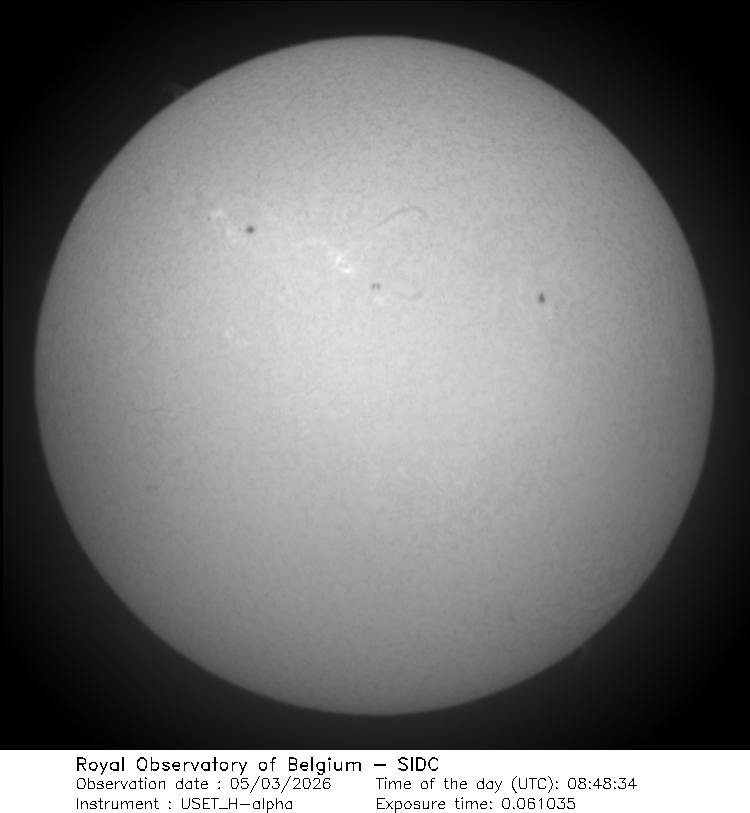
Halpha solar images are produced by the SIDC local observing facilities (Uccle Solar Equatorial Table). The CCD camera is a Qimaging Retiga 4000R. It has an inter-line transfer detector of 2048x2048 pixels. Each pixel is 7.5 micron x 7.5 micron, and the sensitive area is 15.6 mm x 15.6 mm. The H-alpha filter is made by Solar Spectrum. It has a nominal wavelength of 656.2808nm and a bandwidth of 0.05nm. The telescope is a Celestron 80mm ED refractor. The images are provided in FITS files and quicklook PNGs.
This web page forms part of the European Space Agency's network of space weather services and service development
activities, and is supported under ESA contract number 4000134036/21/D/MRP.
For further product-related information
or enquiries contact helpdesk. E-mail: helpdesk.swe@esa.int
This product can also be used via a Web API (application programming interface) for programmatically accessing the images by requesting specific URL-encoded parameters.
The list of mandatory and optional variables for this specific product are included in tables 1 and 2 below:
Variable
Values required for this product
pc
S103
psc
a
component
latest | archive
Table 1: Mandatory parameters for API access to SIDC/USET Hα Solar images.
Variable
Values
dts_start, dts_end
yyyy-MM-ddTHH:mm:ssZ
filetype
png (default) | fits
Table 2: Optional parameters that can be set to refine the query.
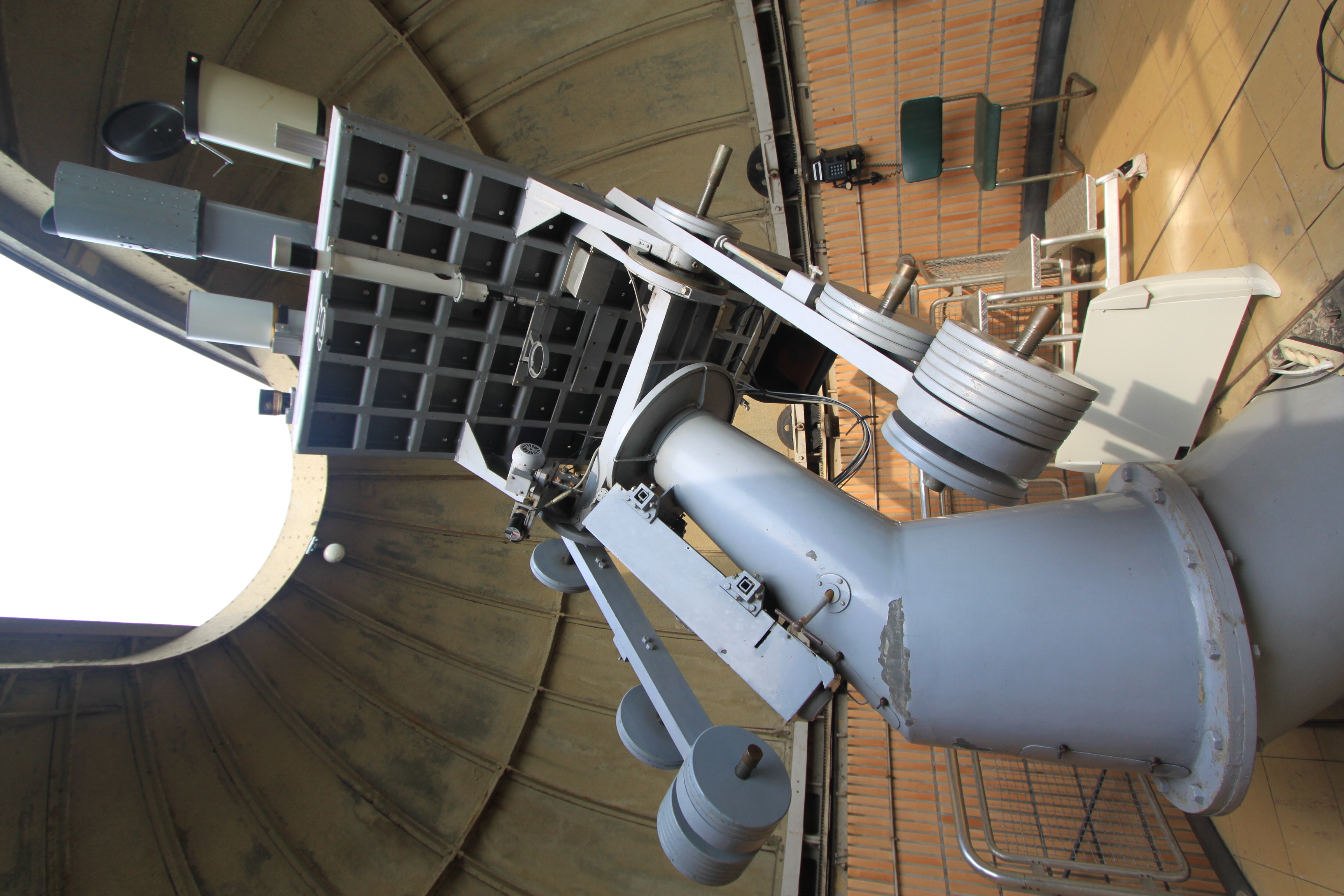
The Uccle Solar Equatorial Table (USET) is the optical solar monitoring facility at the Royal Observatory of Belgium located in Uccle (Brussels), see figure 1.
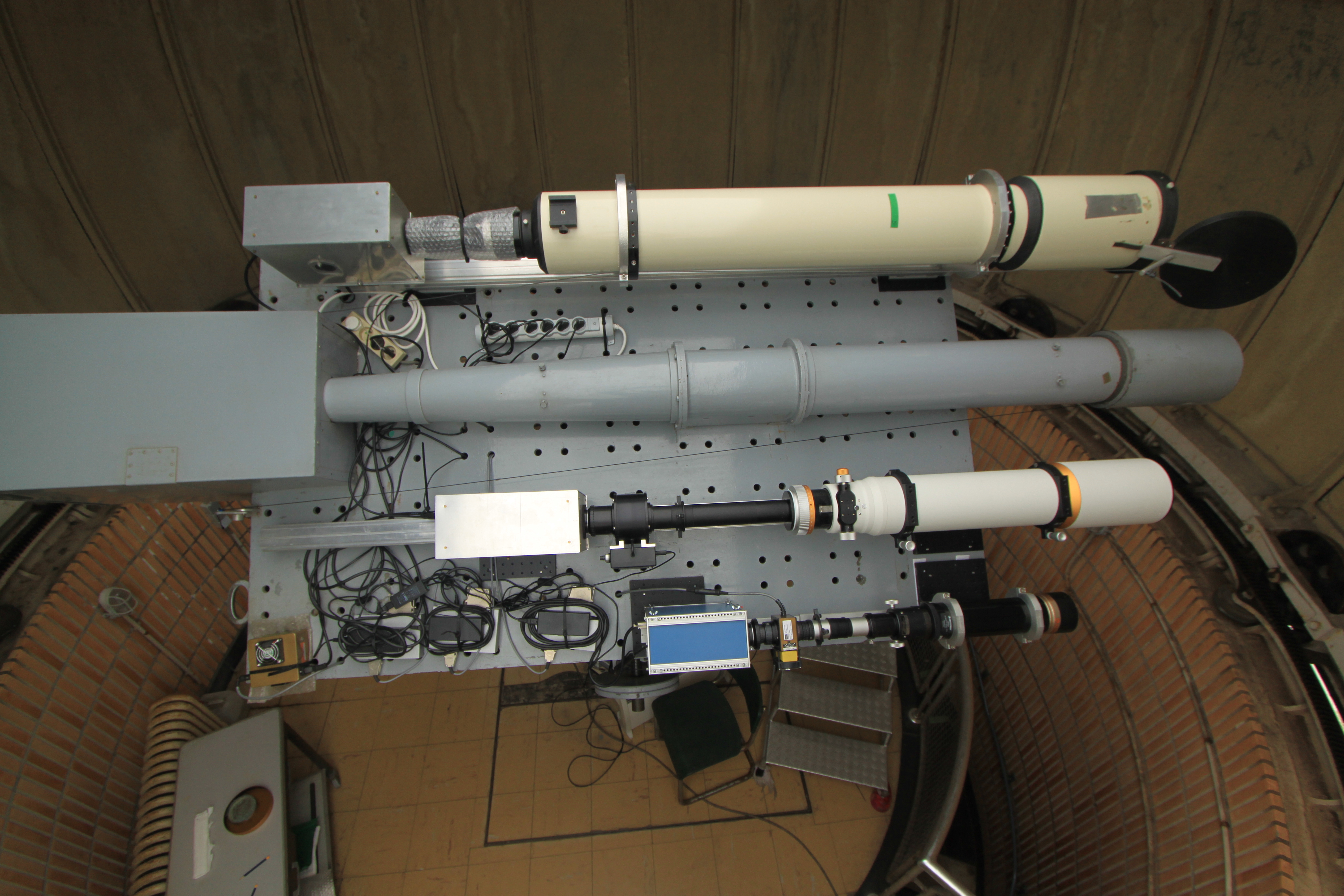
The platform allows a precise continuous tracking of the Sun and holds four solar telescopes, see figure 2,
imaging the Sun in visible light (used to make sunspot drawings by an operator,
see SIDC/USET Sunspot Group Characteristics),
white light (SIDC/USET White Light Solar Images),
Hα light, and Calcium II K.
The USET produces synoptic observations of the whole solar disc when the local weather permits, which is on an average about 250 days a year.
The objectives of the USET are the production, archiving, distribution and exploitation of global information about structures and events in the photosphere and chromosphere,
as part of the continuous world-wide ground-based monitoring of solar activity.
Figure 1: The Uccle Solar Equatorial Table (USET) with the orientation of the telescopes visible.Figure 2: The telescopes mounted on the USET, from top to bottom: white-light, visual white light, Calcium II K and Hα.
Technical information
Since 2008, the Hα telescope has been equipped with a CCD Qimaging Retiga 4000R camera. It has an inter-line transfer detector of 2048×2048 pixels.
Each pixel is 7.5×7.5 microns, and the sensitive area is 15.6×15.6 mm. The H-alpha line is obtained using a Fabry-Pérot monochromator made by Solar Spectrum.
It has a nominal wavelength of 656.2808 nm and a bandwidth of 0.05 nm. The telescope is a
Celestron 80 mm ED refractor.
Prior to this, from 2002-2008, the Hα telescope was equipped with a Lyot filter and a 1 MP camera (1024×1024 pixels).
The images are provided in FITS files and quicklook PNGs with a time cadence of about 5 minutes. The archive of Hα images begins 21 May 2002 at 17:28 UT
(there are two non-solar image test FITS files from 26 February 2002). The first image using current camera is from 31 March 2008 at 15:19 UT.
However, images oscillate between the 4 and 1 MP cameras with the final 1024×1024 pixel image on 24 June 2008 at 15:09 UT.
Limitations and caveats of the data
Data gaps are possible since observations of the Sun are only available when the weather permits, i.e. when it is not too cloudy.
The data are recorded during the daylight hours. Therefore, in winter the observation periods start later and end earlier due to the low height of the Sun.
Use and functionality of the product
The Latest tab shows the most recent quicklook PNG image with the link to the latest FITS file above.
Both are accessible via the API.
The Query tab displays a list of the archived quicklook PNG images and FITS files going back to 21 May 2002. The lists give the date with time and the filename for each of the images.
The exposure time [in seconds] is provided for the FITS files, and the size in kB for the PNG files.
The list can be filtered by providing start and end dates in the format yyyy-MM-ddTHH:mm:ssZ.
For example, entering the start date 2020-11-01T00:00:00Z and end date 2020-11-30T23:59:59Z and clicking submit
will return two lists of all of the images available from November 2020.
Both are accessible via the API.
The top menu navigation bar allows to browse through the products (across the different "Solar Weather" providers) as follows:
Help: Provides more details on the data products, their properties, constraints and access methods, the providing Expert Group as well as this general help on navigation.
Similar products: Navigate to products offering the same type of data but from other providers/instruments.
Related products: Navigate to products that are related in the sense that e.g. one product provides input to the other, or one product is the forecast of the quantity which is measured in the other product.
Latest: Switch to page showing the latest data.
Query: Switch to page offering archive query functionalities.
Email Subscription: Switch to page for email subscription of service.