Spacecraft Design - Environment specification: data archive
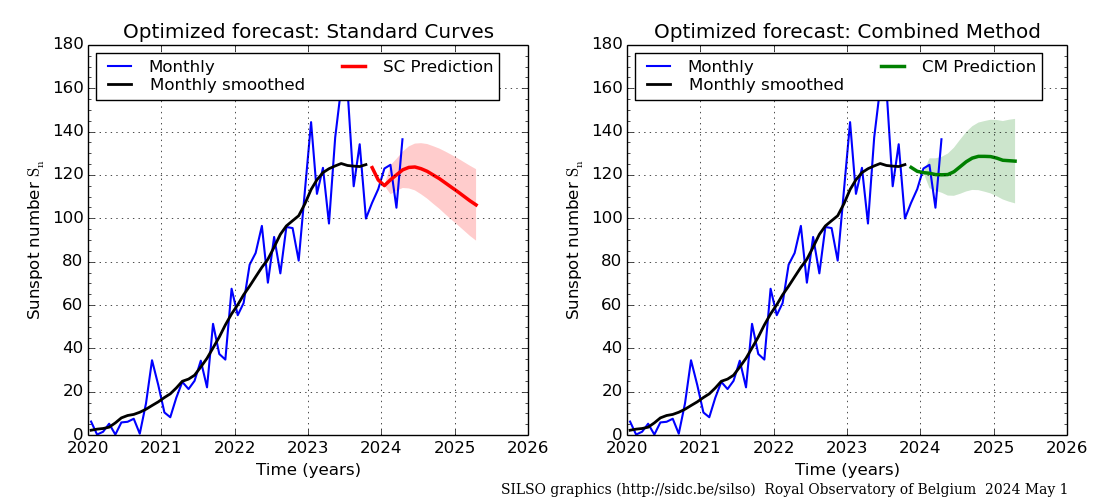
Medium-term predictions of the smoothed monthly sunspot number obtained by applying an adaptative
Kalman filter to the primary methods (© WDC-SILSO, Royal Observatory of Belgium, Brussels)
The service "Spacecraft Design - Environment specification: data archive" aims to provide for past or future spacecraft statistical information on the space environment (i.e. ionising radiation, plasma, microparticles, atmosphere, and UV) and its effects (e.g. dose, single event upset, sensor background, cumulated charge, spacecraft anomalies, microparticle impacts), as well as, long-term solar cycle prediction since several spacecraft effects exhibit solar cycle variation. Such information are needed for tailored design of space systems especially in relation to radiation protection, electromagnetic compatibility and microparticle impacts. The service is intended for personnel involved in generating space environment specifications for the design of spacecraft.
The service is implemented through a set of models and in-orbit sensor datasets with the help of tools such as
- the Space Environment Information System (SPENVIS) coupling several empirical and engineering models of the space environment and its effects on spacecraft or components based on a mission planning;
- the Space Environment Data System (SEDAT) allowing to carry out engineering analyses on datasets related to the spacecraft charged particle environments;
- the Solar Energetic Particle Environment Modelling application (SEPEM) allowing solar energetic particle statistical analyses on an extended set of cross-calibrated data.
This service page is curated by the ESC Space Radiation. For further information, please contact SSCC Help-desk.

SOHO/LASCO coronagraph image showing
contamination by energetic particles
associated with solar activity (© ESA)

Impact crater (size 4 mm) on solar cell
retrieved from space (© ESA)
The space environments considered include energetic particle radiation, plasmas, atmospheres, micro-particles, and contamination. They can all cause serious problems for space systems that need to be carefully taken into account during the development of spacecraft. The radiation environment, consisting of radiation belts, cosmic rays, and solar energetic particles causes effects such as radiation damage, single-event upsets in electronics, background in detectors, and health hazards to astronauts. The plasma environment increases electrostatic charging of spacecraft parts or affects scientific instruments. The residual upper atmosphere causes surface erosion by atomic oxygen. Finally the micro-meteoroids and space debris environments introduce significant risks for manned and unmanned spacecraft.
A possible starting point when preparing space environment specifications for a spacecraft design is the Space Environment Information System (SPENVIS). This tool allows to execute a set of space environment models based on a mission scenario (mission duration, typical spacecraft trajectories and spacecraft attitude) and to evaluate impacts and risks by propagating the results into engineering models. The tool includes graphical visualisation and an extended help with background information and references to the European standards. For a more comprehensive analysis of the space environment effects, the SPENVIS output could be exported to more specific applications, such as GRAS (Geant4 Radiation Analysis for Space) or SPIS (Spacecraft Plasma Interaction Software), that are taking into account the detailed geometry of the spacecraft.
When the available models don't include the appropriate statistical information, a tool such as SEDAT (Space Environment DATa system) could be considered. SEDAT allows to carry out a wide range of engineering analyses using a comprehensive set of in-situ space environment datasets. The tool flexibility authorizes to tailor the processing of the data to the problem under study, and, to incorporate new datasets.
The Space Environment Standard ECSS-E-ST-10-04 (see Auxiliary Info) provides principles for determining the local induced environment and guidelines for the model and parameter selection process. The table below summarizes typical programmatic concerns related to the space environment.
| Thermosphere | Solar radiance | Plasma | Microparticles | Ionizing radiation | Magnetic field | |
|---|---|---|---|---|---|---|
| Avionics | Thermal design | Upsets due to electromagnetic interference from arcing, spacecraft charging | Electromagnetic interference due to impacts | Single event upsets, bit errors, bit switching | Induced potential effects | |
| Electrical Power | Degradation of solar array performance | Solar array designs, power allocations, power system performance | Shift in floating potential, current losses, contaminant reattraction | Damage to solar cells | Decrease in solar cell output | Induced potential effects |
| Guidance, navigation & control, and pointing | Overall design of GN&C and poiting system | Density and drag variation, induced gravity gradient torques | Torques due to induced potential | Collision avoidance | Sizing of magnetic torquers | |
| Materials | Material selection, material degradation (atomic oxygen erosion) | Material selection, Solar UV exposure | Arcing, sputtering, contamination effects on surface properties | Degradation of surface | Degradation of materials | |
| Optics | Spacecraft glow, interference with sensors | Design of optical systems | Contaminants reaatraction, change in surface optical properties | Degradation of surface optical properties | Darkening of windows and fiber optics | |
| Propulsion | Drag makeup, fuel requirement | Density and drag variation | Shift in floating potential due to interaction of thruster firing | Collision avoidance, fuel requirement increase for shielding, pressurized tank rupture | ||
| Structures | Placement of thermal sensitive structures, fatigue, thermally induced vibrations | Mass loss from arcing & sputtering, Spacecraft charging effects | Structural damage, Design of shielding, spacecraft weight, crew survivability | Induced current in large structures | ||
| Telemetry, tracking and communication | Possible tracking error or loss | Tracking accuracy, Density and drag variation | Electromagnetic interference due to arcing | Electromagnetic interference due to impacts | South Atlantic Anomaly location | |
| Thermal control | Reentry loads & heating, surface degradation (atomic oxygen) | Radiator sizing, influence on reentry thermal heating | Change in absorptance/emittance properties, reattraction of contaminants | Change in thermal properties | ||
| Mission operations | Reboost timelines, spacecraft lifetime assessment | Mission planing and timelines | Crew survivability | Crew replacement timelines |
For further information, please contact SSCC Help-desk.
Solar Activity: Model and Medium-term Forecast
Solar Activity: Data Archives

- Solar index archive for thermospheric drag calculation

- SSN archive on SEDAT

- Solar index archive for thermospheric drag calculation
Interplenatary Medium at L1: Model and Medium-term Forecast
- SPENVIS Short-term solar particle models

- SPENVIS Long-term solar particle models
- SPENVIS Galactic cosmic ray models
- SPENVIS Short-term solar particle models
- SPENVIS Long-term solar particle models
- SPENVIS Galactic cosmic ray models
- SPENVIS Galactic cosmic ray models
- SPENVIS Galactic cosmic ray models
- Empirical solar wind speed forecast
Interplenatary Medium at L1: Data Archives
- High-energy SEP event catalogue
- SEPEM Reference proton data set
- SEPEM Reference proton data set
- Geomagnetic activity index archive for thermospheric drag calculation
Magnetospheric Environment: Model and Medium-term Forecast
- SPENVIS Standard radiation belt models
- SPENVIS IRENE Radiation belt models
- SPENVIS Short-term solar particle models
- SPENVIS Long-term solar particle models
- SPENVIS Galactic cosmic ray models
- SPENVIS Short-term solar particle models
- SPENVIS Long-term solar particle models
- SPENVIS Galactic cosmic ray models
- SPENVIS Standard radiation belt models
- SPENVIS IRENE Radiation belt models
- SPENVIS Short-term solar particle models
- SPENVIS Short-term solar particle models
- SPENVIS Standard radiation belt models
- SPENVIS IRENE Radiation belt models
- SPENVIS Internal deep dielectric charging
- SPENVIS Surface charging environment characteristics
- Electron population model at GEO
- Electron population model at MEO
- Electron population model at LEO
- SWIFF Plasmasphere Model (SPM)
- SPENVIS Surface charging environment characteristics
- SWIFF Plasmasphere Model (SPM)
Magnetospheric Environment: Data Archives
- PROBA-V/EPT Proton flux geographical maps
- PROBA-V/EPT SAA proton energy spectrum characterisation
- AZUR/EI-88 dataset on SEDAT
- UARS/PEM-HEPS dataset on SEDAT
- PROBA-V/EPT Proton flux spectra time series
- SEPEM Reference proton data set
- PROBA-V/EPT Helium flux spectra time series
- PROBA-V/EPT Helium flux geographical maps
- PROBA-V/EPT SAA helium energy spectrum characterisation
- AZUR/EI-88 dataset on SEDAT
- UARS/PEM-HEPS dataset on SEDAT
- SEPEM Reference proton data set
- SEPEM Reference proton data set
- PROBA-V/EPT Electron flux spectra time series
- PROBA-V/EPT Electron flux geographical maps
- PROBA-V/EPT Auroral electron energy spectrum characterisation
- GORIZONT/ADIPE Spacecraft charging dataset
- CRRES/LEPA Spacecraft charging dataset
Thermospheric and Atmospheric Conditions: Model and Medium-term
- SPENVIS Atmospheric and ionospheric models
- SPENVIS Atmospheric and ionospheric models
Thermospheric and Atmospheric Conditions: Data Archives
Microparticle Environment: Model and Medium-term Forecast
- SPENVIS Meteoroid flux models
- SPENVIS Meteoroids and debris models
- SPENVIS Meteoroids and debris models
Microparticle Environment: Data Archives
- PROBA/DEBIE-1 impact dataset on EDID
- ISS/DEBIE-2 impact dataset on EDID
- Express-2/GORID impact dataset on EDID
Spacecraft Effects and Anomalies: Model and Medium-term Forecast
- SPENVIS Long-term SEUs and LET spectra
- SPENVIS Short-term SEU rates and LET spectra
- SPENVIS Particle/wall interaction models
- SPENVIS Ionising dose for simple geometries
- SPENVIS Non-ionising energy loss for simple geometries
- SPENVIS Effective dose and ambient dose equivalent
- Geant4-based effect simulation in SPENVIS
- SPENVIS Solar cell damage equivalent fluences
- SPENVIS Solar cell NIEL-based damage equivalent fluences
- SPENVIS Internal deep dielectric charging
- SPENVIS Surface charging
- SPENVIS Solar array and spacecraft structure potentials
Spacecraft Effects and Anomalies: Data Archives
- PROBA-1/SREM radiation rates
- Integral/SREM radiation rates
- Rosetta/SREM radiation rates
- Herschel/SREM radiation rates
- Planck/SREM radiation rates
- Radiation environment outside the ISS
- Radiation environment inside ISS
- Accumulated dose in human phantoms on ISS
- Accumulated dose catalogue during SW events
- GORIZONT/ADIPE Spacecraft charging dataset
- CRRES/LEPA Spacecraft charging dataset
Long-term solar cycle prediction
SPENVIS (Space Environment Information System) is a web-based interface for assessing the space environment and its effects on spacecraft systems and crews. The system is used for mission analysis and planning. SPENVIS includes several empirical models of the space environment covering mainly cosmic rays, solar energetic particles, the natural radiation belts, magnetic fields, space plasmas and the upper atmosphere. A range of engineering models are also available to help assess the effects of the space environment on spacecraft such as surface and internal charging, energy deposition, solar cell damage and SEU rates. Usually these later models take their inputs from the empirical models present in SPENVIS. The system also includes extensive background information on the space environment, the environment models and the related standards.
SEDAT (Space Environment Data System) is a tool for the engineering analysis of spacecraft charged particle environments. The facility provides access to the ODI database containing a large and comprehensive set of data about that environment as measured in-situ by a number of space missions. The user can select a set of space environment data appropriate to the engineering problem under study. SEDAT also offers a set of software tools, which can operate on the data retrieved from the database. These tools allow the user to carry out a wide range of engineering analyses. SEDAT is using a GUI written in Java.
SEPEM (Solar Energetic Particle Environment Modelling) is a WWW interface to solar energetic particle data and a range of modelling tools and functionalities intended to support space mission design. The system provides an implementation of several well known modelling methodologies, built on cleaned datasets. It also gives the user increased flexibility in his/her analysis and allows generation of mission integrated fluence statistics, peak flux statistics and other functionalities. It also integrates effects tools that calculate single event upset rates and radiation doses for a variety of scenarios.
EDID (European Debris Impact Database) provides automated data processing and dissemination functions for measurements retrieved from European debris and meteoroids impact detectors. It covers impacts from the DEBIE-1, DEBIE-2 and GORID detectors. Users can access more than 3,000,000 debris and micro-meteoroid event records plus sensor and spacecraft housekeeping data via a user-friendly web interface. Filters can be defined for each available parameter and be used for regular data retrieval.
No alerts is associated to this service.
Debris Cloud/Meteoroid Stream Warning
This section provides links to web pages or resources that are not part of the SSA Space Weather Network or esa.int domain. These sites are not under ESA control, and ESA is not responsible for the information or links you may find there.
Reference documents
- ECSS-E-ST-10-04C Space environment (15 November 2008)
- ECSS-E-ST-20-06C Spacecraft charging (31 July 2008)
- ECSS-E-ST-10-12C Method for the calculation of radiation received and its effects, and a policy for design margins (issued on 15 November 2008)
- ECSS-E-HB-10-12A Calculation of radiation and its effects and margin policy handbook (issued on 17 December 2010)